
Chapter Three - What Clients Will Pay More For

12 Part Series from:
ADVISOR MASTERY IN THE AGE OF AI
Where the Value of Advice Is Moving — and How to Move with It
by F. David A. Miller © 2026 Mindset Publishing. All rights reserved.

Part 1 - The New Environment cont.
The previous chapter ended with an observation: everything on the list of what clients will no longer pay for is production.
The report is production. The plan document is production. The market letter, the comparison, the projection, the summary and the automated message are all production. They are things a business makes.
That observation was left standing on its own because it deserves a chapter, not a paragraph. It is the key that unlocks the entire question of advisor value in the age of artificial intelligence.
This chapter is the second list — the stronger one. It describes where the value of advice is moving, why that movement favours the excellent advisor, and how to test every service in the practice against the new reality.
The Difference Between Production and Responsibility
The work most vulnerable to AI shares a common characteristic: it involves production.
AI can produce an explanation, a summary, a checklist, a report, a first draft, a scenario, a meeting agenda or a model allocation. Production is important. It is simply becoming inexpensive.
The work least vulnerable to AI involves responsibility.
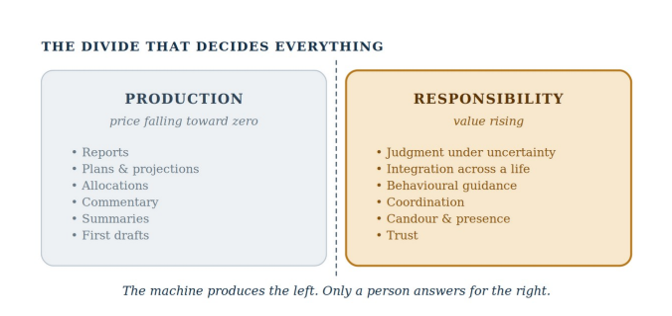
Someone must decide whether the information can be trusted. Someone must determine whether it applies. Someone must reconcile competing goals. Someone must say no to an attractive but unsuitable idea. Someone must coordinate the accountant, the lawyer, the banker, the insurance professional and the family. Someone must notice that an agreed action has not been completed. Someone must remain present when markets fall, a spouse dies, a business is sold or a family disagreement turns financial.
AI can assist with all of these activities. It cannot bear responsibility for the client’s life.
This creates the central economic divide of the AI era:
Production will become cheaper. Responsibility will become more valuable.
Advisors who continue to charge for production will face pressure. Advisors who use cheaper production to assume greater responsibility will strengthen their position.
Every section that follows is a form of responsibility. None of them is new. They are the capabilities that excellent advisors have always possessed. What is new is that AI will make it increasingly difficult to hide their absence behind information, activity and presentation.
Where Value Will Migrate
When something that was once scarce becomes abundant, value does not disappear. It moves. Chapter One established that principle for intelligence itself. This is where it lands.
As information and routine analysis become abundant, value will migrate toward the capabilities that remain scarce.
Context
General information is plentiful. A complete understanding of a particular client is not.
Context includes the client’s assets and liabilities, but it also includes family, business, health, history, temperament, obligations, ambitions and fears. It includes the reasons behind past decisions and the commitments already made to other people.
The same strategy can be appropriate for one client and harmful to another because the context is different. Clients will pay for advice that reflects their complete situation, because no abundant source of answers holds that situation in trust the way their advisor does.
Priority
Clients often have several legitimate objectives and insufficient resources to pursue all of them at once.
The problem is not a lack of answers. It is deciding what matters first.
An advisor creates value by helping the client distinguish the urgent from the important, the attractive from the necessary and the financially optimal from the personally appropriate.
Integration
Financial decisions interact.
An investment decision can affect tax. A tax decision can affect an estate. A business decision can affect family relationships, retirement income, insurance needs and charitable intentions. Specialists may provide excellent advice within their areas while no one takes responsibility for the complete picture.
Clients will pay for integration when taxes, investments, estate structures, insurance, debt, business interests and family intentions collide. The advisor who integrates those perspectives creates value that cannot be measured by any single recommendation.
Judgment Under Uncertainty
Many important decisions must be made before all the facts are known.
Markets are uncertain. Tax rules change. Businesses evolve. Families surprise us. Health changes. Even the client’s future preferences cannot be known with certainty.
Chapter One drew the line between capability and judgment: capability asks whether a thing can be done, judgment asks whether it should be done, whether it should be done now, what might be missing, what happens if we are wrong, and who is answerable for the decision. That line matters most precisely here. Under uncertainty, the machine's advantage is at its smallest, because its command is over what is knowable — and the facts that will decide the outcome are the ones nobody has yet.
Judgment under uncertainty also adds something the earlier discussion did not: the recognition that the best decision is often the one that preserves flexibility. Not the optimal path given the assumptions, but the path that survives being wrong about them. A machine optimizes against the assumptions it is handed. A person decides how much weight those assumptions deserve in the first place.
Clients will pay for judgment when there is no perfect answer — which is to say, whenever the decision truly matters.
Behaviour
A technically excellent strategy fails if the client cannot follow it.
Advisors see the distance between what people intend to do and what they actually do. They help clients avoid decisions driven by panic, excitement, procrastination, pride or the desire to escape temporary discomfort.
Information can explain what should happen. Relationships and accountability help it happen.
Clients will pay for behaviour management when fear or greed threatens a sound plan. Independent research has repeatedly found that behavioural coaching is among the largest single contributors to the value an advisor delivers — larger than product selection, and invisible on every statement.
Coordination
Complex clients often have several advisors, each possessing a portion of the truth.
Someone must ensure that the accountant understands the estate intention, the lawyer understands the ownership structure, the investment advisor understands the liquidity requirement and the family understands the decision that will eventually affect them.
AI may improve the flow of information. Responsibility for coordination remains a human role. Clients will pay for coordination when multiple professionals see only their piece of the problem — because the cost of an uncoordinated decision is borne entirely by the client.
Restraint
Much of financial services is rewarded for action. Products are sold. Portfolios are changed. Transactions are completed. Strategies are implemented.
Yet some of the most valuable advice is to do nothing.
Do not sell in panic. Do not pursue the tax strategy until the legal consequence is understood. Do not transfer the business merely because a transaction is available. Do not change a sound plan because another approach performed better last year.
Restraint requires confidence, independence and judgment. It is difficult to commoditize because its value lies in an action that never occurred.
Implementation and Accountability
A good idea that is never completed has no value.
The industry produces recommendations far more reliably than it produces completed actions. The estate documents that were never updated, the insurance that was never placed, the beneficiary designation that was never corrected, the exercise window that quietly expired — these failures rarely appear in any report, and they can cost more than a decade of fees.
Clients will pay for implementation because ideas do not protect families; completed actions do. And they will pay for accountability when delay, avoidance or inertia becomes expensive — for the professional who notices that an agreed action has not happened and does not let it disappear.
Continuity, Candour and Care
Three forms of value become visible only when life becomes difficult.
Continuity. In many families, one spouse has delegated the finances. The other needs confidence that the family will be cared for — that the plan, the relationships and the institutional memory survive the person who managed them. A practice built on documented understanding provides that confidence. A practice built on one person’s memory cannot.
Candour. Machines are agreeable. They will refine a flawed idea all day without ever saying that the idea itself is the problem. Clients will pay for candour when the truth is uncomfortable — the spending that is unsustainable, the heir who is not ready, the business that is worth less than believed. Telling a client what they need to hear, at personal risk to the relationship, may become one of the clearest signatures of human advice.
Care. When a spouse dies, a diagnosis arrives or a business fails, the client does not need a document. They need a person who knows them, who shows up and who takes work off their shoulders at the moment they can carry the least. AI can prepare everything except the presence.
Trust
Finally — and above everything on this list — clients will pay for trust.
Not trust as a vague feeling, and not trust as a claim in a brochure. Trust as the accumulated result of competence, transparency, consistency and concern, demonstrated over time.
Every capability in this chapter compounds into it. Context earns it. Judgment justifies it. Candour proves it. Implementation and accountability renew it. Trust is the only asset on this list that cannot be produced quickly at any price, which is precisely why its value rises as everything producible becomes cheap.
The New Value Equation
The old value equation was often built upon an imbalance:
The advisor possessed knowledge, access or analytical capability that the client did not have.
The new value equation must be built upon application:
The advisor helps the client use abundant knowledge with context, judgment, discipline and responsibility.
This does not mean knowledge becomes irrelevant. The advisor must know more than ever — but knowing is now the entry fee, not the value. The value of an advisor was never the spreadsheet. It was never the pie chart, the market letter or the list of funds. Those were tools through which value could be delivered. The real value has always been the advisor’s ability to understand a person, bring order to complexity, exercise judgment, guide decisions and remain accountable for what happens next.
Artificial intelligence does not destroy that value. It exposes whether it was there in the first place.
A New Test for Every Service
Understanding where value is moving is only useful if it changes what the business does. Every advisor should now examine the practice service by service.
For each activity, ask:
Is this valuable because it is difficult to produce, or because it helps the client make a better decision?
Could a capable client obtain a similar answer from AI or a low-cost platform?
Does this service reflect real knowledge of the client, or only the appearance of personalization?
Does it lead to a decision, an action, a reduced risk or greater confidence?
Who is responsible for ensuring that the recommendation is correct and implemented?
If AI reduces the time required, how will the recovered capacity improve the client’s experience?
Can the client clearly connect this service to the fee being paid?
Some activities should be automated. Some should be improved. Some should be eliminated. Some should remain fundamentally human but supported by better information.
The objective is not to protect every existing task. The objective is to protect and increase the value of the relationship.
This requires intellectual honesty. Advisors must be willing to admit that certain things they once considered expertise are becoming utilities. They must also resist the opposite error: assuming that because AI can participate in an activity, the human contribution has disappeared.
The Principle
The two lists — this chapter and the last — reduce to a single statement:

Direction is the word that matters. Context, priority, integration, judgment, behaviour, coordination, restraint, implementation, accountability, continuity, candour, care and trust — each one converts abundant answers into a life that actually goes the way the client intended.
Knowing where value is moving, however, is not the same as being organized to deliver it. Most practices are still structured around production — their time, their staffing and their processes are arranged to make things. Redirecting a business toward responsibility requires a deliberate framework: knowing what to automate, what to accelerate, what to elevate and what to protect. That framework is the subject of the next chapter.
— end of chapter three —
NEXT WEEK
Chapter Four
Intelligent Leverage
Adapted from Advisor Mastery in the Age of AI by F. David A. Miller.
© 2026 Mindset Publishing. All rights reserved.
Chapter Three Principles
Production and responsibility are dividing. AI makes production cheap; responsibility — deciding, verifying, coordinating, standing behind outcomes — becomes more valuable.
Value migrates to what remains scarce. Context, priority, integration, judgment, behaviour, coordination, restraint, implementation, accountability, continuity, candour, care and trust cannot be produced on demand.
Context is the raw material of advice. The same strategy can be right for one client and harmful to another; only the advisor holds the complete picture in trust.
Capability is not judgment. Capability asks whether something can be done; judgment asks whether it should be done, now, by whom, and at what human cost.
Behaviour is where plans succeed or fail. Information explains what should happen; relationships and accountability make it happen.
Restraint is real advice. Some of the most valuable recommendations are actions that never occur, which is why restraint resists commoditization.
An idea never completed has no value. Implementation and follow-through, not recommendations, are what protect families.
Candour and care are human signatures. Machines are agreeable and absent; advisors are paid to be truthful and present.
Trust is accumulated, not claimed. It is the compounded result of competence, transparency, consistency and concern — and its value rises as everything producible becomes cheap.
Test every service. If an activity does not lead to a better decision, a completed action, a reduced risk or greater confidence, it should be automated, improved or eliminated.
Research Notes
Vanguard, Putting a Value on Your Value: Quantifying Advisor’s Alpha. Vanguard’s ongoing research framework estimates that advisors can add meaningfully to client outcomes — on the order of several percentage points of net value — and identifies behavioural coaching as the largest single contributor, supporting this chapter’s argument that behaviour, not production, carries the fee.
Blanchett, D. and Kaplan, P., Alpha, Beta, and Now… Gamma (Morningstar, 2013). The study quantifies the additional retirement income generated by intelligent planning decisions — asset location, withdrawal sequencing, dynamic strategy — rather than product selection, reinforcing the migration of value from production toward integration and judgment.
CFP Board, Leading the Future: Harnessing AI in the Financial Planning Profession (November 2025). The report identifies empathy, behavioural coaching, ethics and human-centred competence as continuing sources of professional value as AI absorbs analytical production.


Comments